
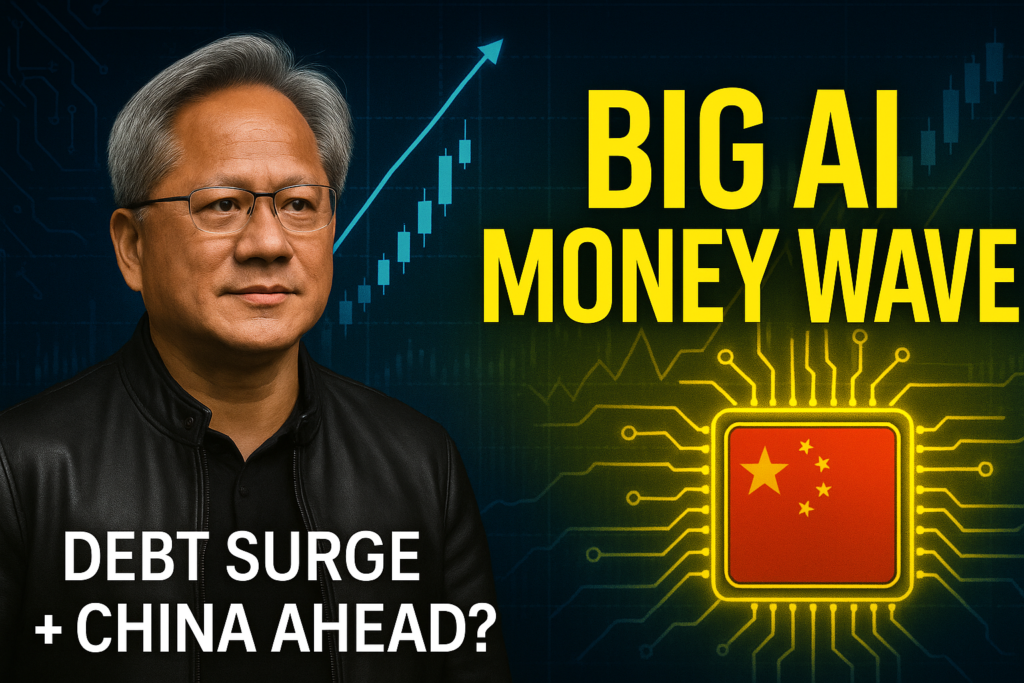
Nvidia CEO Jensen Huang says: “China will win the AI race”
Artificial Intelligence is no longer an experimental sector — it has become the core engine of the global technology economy. Big tech companies are investing billions to expand computing capacity, build GPUs, acquire AI startups, and train large-scale models. As spending rises sharply, analysts expect a significant increase in corporate debt issuance next year, especially from US-based tech giants.
Big Tech is Spending Aggressively on AI
Major players like Microsoft, Apple, Meta, Amazon, and Google have already increased their AI budget. They are building data centers, scaling cloud infrastructure, and competing for GPU supply. However, even with huge cash reserves, companies may need to raise more capital to keep pace with innovation. Because AI development requires heavy upfront investment, many firms may prefer issuing corporate bonds instead of pulling from cash holdings.
Furthermore, rising M&A activity shows how fast the market is moving. Big tech companies are purchasing smaller AI startups for talent, patents, and proprietary models. As a result, we may see record levels of financing and debt issuance in 2026.
Jensen Huang: “China Will Win the AI Race“

Nvidia CEO Jensen Huang, known for shaping the AI hardware revolution, recently stated that China is likely to win the AI race. His view is based on China’s scale, fast adoption, and government-backed support for technological growth. Although the US remains strong in innovation and research, China is rapidly increasing GPU manufacturing, chip design, and AI deployment across industries.
Huang’s comment signals a shift — AI leadership may no longer be only an American story. Competition is global, intense, and now heavily influenced by economic power rather than pure technology.
Debt Issuance Could Reshape AI Economics
When companies raise more debt:
- They get immediate capital for expansion
- AI development speeds up
- Mergers and acquisitions grow
- Infrastructure scales faster
Still, higher debt also brings interest burden and repayment pressure. Therefore, investors will track how efficiently these companies convert AI spending into revenue — especially through cloud AI services, enterprise automation, and consumer AI platforms.
What will next ?
We’ve been treating inference like some magical black box.
— Artificial Intelligence (AI) • ChatGPT (@chatgptricks) December 3, 2025
Defining tasks, specs, and clearing rules is how real markets form.
Feels like the first step toward a proper intelligence economy. https://t.co/V3H40EY6Ub
Going forward, the AI industry will enter a phase of capital-intensive growth, fueled by innovation, competition, and national strategies. If Big Tech finances the next wave of AI with large debt issuance, global markets may experience a powerful boost — and the race for dominance will accelerate.
One thing is clear: AI is the new industrial revolution, and the countries or companies leading it today may shape the global economy for decades.